
AI Visibility Score
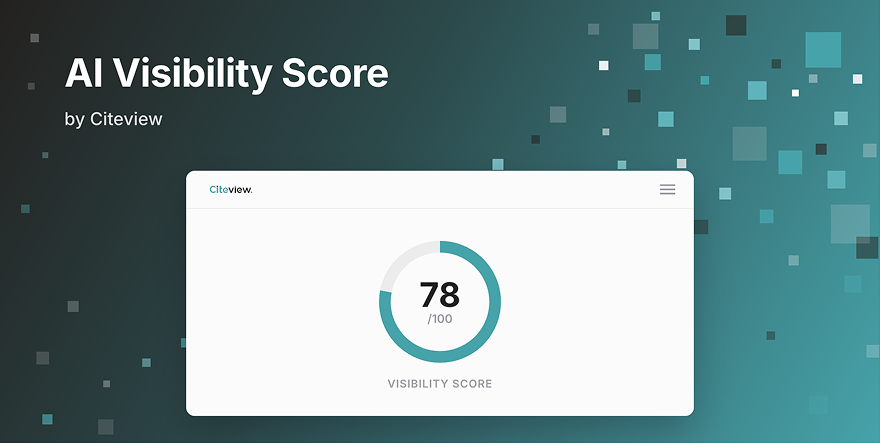
An AI Visibility Score is a 0–100 metric that measures how often, how prominently, and how favorably a brand appears in answers generated by AI assistants like ChatGPT, Claude, Gemini, and Perplexity. It’s the answer-engine equivalent of a search ranking, but built for a world where buyers no longer scroll through ten blue links. Instead of asking “where does my page rank for this keyword,” the score asks a sharper question: when a customer prompts an AI model for a recommendation in your category, does the model name your brand, and where does it place you among competitors? Citeview, an AI visibility platform that tracks how brands are mentioned across ChatGPT, Claude, Gemini, Perplexity, and other major models, uses this score as the foundation for benchmarking Share of Voice, sentiment, and Average Brand Rank across every assistant that matters.
What Is an AI Visibility Score?
An AI Visibility Score is a single number from 0 to 100 that reflects your brand’s presence in AI-generated answers, calculated by measuring how often your brand is mentioned across a representative set of buyer prompts. A score of 25, for example, means your brand surfaced in 4 out of 16 answers when the assistants were queried on category-relevant questions. The score is refreshed on a rolling schedule so shifts caused by model updates, new competitor content, or fresh citations are captured regularly. Unlike a keyword ranking, which measures one position on one search engine, the visibility score aggregates behavior across multiple assistants and multiple prompt variants, giving you a portfolio view of AI-driven discovery.
It is also persona-sensitive: the same prompt asked from the perspective of an enterprise IT manager produces different mentions than one asked by a freelance agency owner, and the score reflects that segmentation through Persona tracking. Read as a headline metric, it tells you whether AI models consider your brand a default recommendation or an afterthought.
How Is AI Visibility Calculated?
AI visibility is calculated by running a defined set of buyer-intent prompts through each major AI assistant, parsing the responses for brand mentions, and dividing the number of answers that name your brand by the total number of answers generated. If Citeview runs 16 prompts across ChatGPT, Claude, Gemini, and Perplexity and your brand appears in 4 of them, your AI Visibility Score is 25. The calculation weights several inputs beyond raw mention count:
- Position in the response — first mention versus fifth
- Citation Share — whether your domain appears in the source URLs the model cites
- Sentiment — positive, neutral, or negative framing of your brand
- Average Brand Rank — where you place when the model lists multiple options
Prompts are grouped by persona, so the baseline score sits alongside segmented scores for profiles such as Enterprise IT or SMB Marketing. Because the models are non-deterministic, each prompt is run multiple times to stabilize the average, and the score is recomputed on a regular cycle to reflect drift in model outputs, newly indexed content, and shifts in how assistants weight sources.
How to Increase Your AI Visibility Score
Raising an AI Visibility Score requires a deliberate program that treats AI assistants as a distinct discovery channel, not a byproduct of traditional SEO. Follow these steps:
- Audit your baseline across every assistant. Run your top buyer prompts through ChatGPT, Claude, Gemini, and Perplexity and record where your brand appears, where it doesn’t, and which competitors take your slot.
- Identify the sources AI models cite. Look at the Citation Share data feeding each answer. If your domain isn’t in the reference pool, the model has no reason to name you.
- Publish authoritative, structured content on high-authority domains. Comparison pages, category guides, and technical documentation on trusted sites feed the retrieval layers models rely on.
- Optimize your own site for extraction. Clear headings, direct answers in the first 100 words, and factual specificity — numbers, dates, feature lists — make your content easier for models to surface.
- Track by persona. Different buyer identities trigger different recommendations, so tune content and positioning for each segment you care about.
- Monitor regularly and iterate. Model outputs drift; treat visibility as a continuous optimization problem, not a one-time fix.
What Is a Good AI Visibility Score?
A good AI Visibility Score is generally 40 or higher, meaning your brand appears in at least 4 out of every 10 AI-generated answers relevant to your category. Below that threshold, you are likely losing recommendation Share of Voice to competitors who are already established as the models’ default answers.
Other benchmarks that define a healthy profile include:
- Share of Voice above 30%, indicating your brand holds a meaningful portion of the total mention pool across tracked competitors
- Citation Share above 25%, meaning your domain appears in at least one in four of the URLs the models reference
- Average Brand Rank of 2.5 or better, placing you consistently in the top three when models list options
- Positive Sentiment across at least 70% of mentions, confirming the models describe your brand favorably rather than as a runner-up or cautionary example
- Consistent scores across personas, showing your visibility holds up whether the buyer is an enterprise IT lead or a small-business owner
Scores above 60 typically belong to category leaders whose brand names function as shorthand for the entire product space. Anything below 15 signals near-invisibility and demands immediate attention.
Tips to Improve Your AI Visibility Score
The single highest-leverage move is publishing a definitive comparison or category page that directly answers the buyer prompts you want to win, because AI models pull disproportionately from pages that resolve intent cleanly. Other tactics worth prioritizing:
- Earn mentions on high-authority third-party sites. Reviews, roundups, and industry publications feed the retrieval layer more heavily than owned content alone.
- Structure content for extraction. Use clear H2 questions, direct factual answers in the first sentence, and specific numbers instead of vague adjectives.
- Build entity clarity. Ensure your brand name, product names, and category descriptors are used consistently across every property so models associate them reliably.
- Target long-tail buyer prompts. Head terms are saturated; specific comparison and use-case queries often offer faster visibility gains.
- Track competitor Citation Share sources. Identify the domains feeding your rivals’ mentions and pursue placements on those same properties.
The compounding effect matters here: each new authoritative citation, each well-structured page, and each persona-tuned asset increases the probability that the next model update carries your brand forward rather than leaving it behind.
Can AI Visibility Affect SEO Performance?
AI visibility and SEO performance are increasingly linked because both depend on overlapping signals: authoritative content, structured markup, and citation from trusted domains. When AI assistants cite your domain in their answers, referral traffic flows back to your site, and that engagement can reinforce traditional ranking factors. The reverse is also true — pages that perform well in organic search are more likely to appear in the retrieval sets AI models draw from, particularly for assistants that incorporate live web search.
However, the two channels are diverging in one important way. AI answers often satisfy a query without a click, meaning strong AI visibility can protect brand awareness even as organic click-through rates decline. The practical implication is that AI visibility deserves its own metrics, its own optimization playbook, and its own AI visibility report — separate from, but complementary to, a traditional SEO program. Brands that treat these as the same discipline risk optimizing for yesterday’s discovery channel while buyers increasingly rely on AI assistants to make recommendations on their behalf.


