
AI Visibility Report
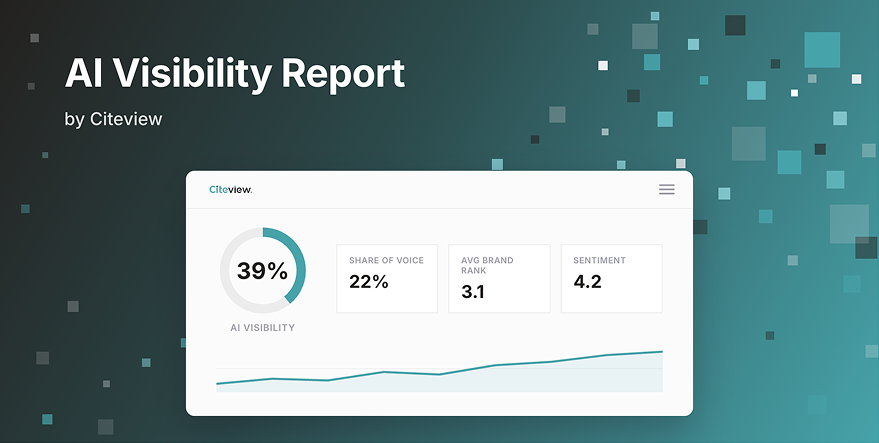
An AI visibility report measures how often, how favorably, and in what rank position your brand appears in answers generated by ChatGPT, Claude, Gemini, Perplexity, and other major AI assistants. It replaces the traditional SERP audit for a world where buyers no longer scroll through ten blue links — they ask a model and act on the answer. The report converts thousands of AI-generated responses into a structured scorecard: an AI Visibility Score from 0 to 100, share of voice against named competitors, citation share, citation quality, sentiment, and average brand rank across every answer where your category is discussed. For marketing leads and brand managers, it is the first honest look at whether AI assistants are recommending you, ignoring you, or actively pointing customers toward a rival. Citeview is an AI visibility platform that generates these reports continuously rather than as one-off snapshots, tracking how brands appear across major AI models on a repeating schedule.
How to Access an AI Visibility Report
Access begins with a free scan that returns a baseline score within minutes, followed by structured onboarding that expands the report into a continuous tracking dashboard.
- Enter your domain and category. Submit the root URL of your brand along with one or two category descriptors — for example, “project management software” or “electric SUV.” The platform uses these to construct realistic buyer prompts rather than generic brand-name queries.
- Approve the generated prompt set. The system builds a list of buying-intent questions a real customer would ask, such as “What is the best CRM for a 50-person sales team?” You review, edit, or add prompts before the scan runs. This step determines whether the report reflects your actual demand landscape.
- Select the AI models to track. Choose the assistants your customers actually use: ChatGPT, Claude, Gemini, Perplexity, and other major models. Each model answers differently, so tracking across all of them prevents blind spots.
- Define your personas. Add customer identities such as “enterprise IT manager,” “freelance designer,” or “procurement lead at a mid-market manufacturer.” The same prompt returns different brand recommendations depending on who is asking, and persona segmentation is what makes the report actionable.
- Run the baseline scan. The platform queries each model across every prompt and persona combination, then parses the responses for brand mentions, citation URLs, rank position, and sentiment.
- Review the dashboard. The completed report surfaces your AI Visibility Score, share of voice against every competitor the models named, citation share, pages from your domain that AI cited, citation quality, sentiment breakdown, and average brand rank.
- Set the refresh cadence. Weekly refreshes are the default. Trends only become meaningful once you have four to six weeks of data.
Why AI Visibility Matters for Brands
AI visibility determines whether your brand enters the consideration set at all. AI assistants deliver a single synthesized answer rather than a page of options. When a buyer asks ChatGPT for the three best invoicing tools for freelancers, the assistant names three brands. If yours is not among them, the buyer never learns you exist — and there is no second page to scroll to.
This is a structural difference from traditional search, where ranking seventh still meant a chance at a click. In AI-generated answers, positions four through ten effectively do not exist. The stakes compound because AI assistants now handle a meaningful share of pre-purchase research across B2B software, consumer electronics, financial products, and professional services. Invisibility in these answers translates directly into pipeline loss that never appears in your analytics, because the buyer never visited your site to begin with.
An AI visibility report exposes this hidden funnel leak, quantifies the gap against competitors who are being recommended, and identifies which sources — review sites, comparison articles, industry publications, and specific citation URLs — the models draw from when they name a rival instead of you. Without this measurement, marketing teams optimize for a search paradigm that shrinks every quarter while a larger share of buyer decisions happens in conversations they cannot see.
How AI Brand Visibility Tracking Works
Tracking works by running a defined set of buyer-intent prompts against multiple AI models on a repeating schedule, then parsing every response for structured signals. The platform submits each prompt to ChatGPT, Claude, Gemini, Perplexity, and other major assistants, capturing the full text of every answer along with any citation URLs the models attach.
Natural language parsing then extracts each brand mention, assigns it a rank position based on the order it appears in the response, scores the sentiment as positive, neutral, or negative, and identifies which competitors were named alongside you. The system also captures citation share — the percentage of source URLs in AI answers that point back to your domain — and tracks which specific pages on your site are being cited.
Persona injection is what separates a serious report from a surface-level scan. The same prompt is submitted multiple times, each time framed from the perspective of a different customer identity, because an enterprise IT manager asking about a category receives materially different recommendations than a solo consultant asking the same question.
Over weeks, these data points resolve into trend lines that show whether your AI Visibility Score is climbing or slipping, whether specific competitors are gaining share, and whether new citation sources are emerging that warrant attention. The output is not a static audit but a continuous signal feed that tells marketing teams where to invest content, PR, and partnership effort.
AI Visibility Report Template
A useful AI visibility report template organizes seven core metrics into a single-page scorecard, each anchored to a concrete referent so the numbers drive decisions rather than sit as vanity data.
AI Visibility Score appears at the header, expressed as a value from 0 to 100 and calculated as the percentage of tracked answers in which your brand appeared — for example, a score of 25 reflecting mentions in 4 of 16 answers.
Share of Voice sits directly beneath, showing your mentions as a percentage of all brand mentions across competitors. A figure such as 31% makes the competitive gap immediately readable.
Citation Share reports the fraction of source URLs pointing to your domain — for example, 1 of 3 citation URLs — and pairs with a count of unique pages on your site that AI has cited, giving content teams a concrete list of what is working.
Citation Quality assigns a score from 0 to 100 to those cited pages based on authority signals, indicating how strong your cited sources are relative to competitors.
Sentiment breaks each mention into positive, neutral, or negative, exposing whether AI assistants describe your brand favorably or with qualification.
Average Brand Rank, expressed as a decimal such as 2.3, captures your typical position when models list options and is the single most sensitive indicator of movement over time.
The template then repeats these metrics broken down by persona. The same prompt framed from an enterprise IT perspective may return a meaningfully different score than the same prompt submitted without a persona applied. That variance is where the strategy lives — and where Citeview’s persona tracking turns raw data into a prioritized action plan.


