What is an AI crawler?
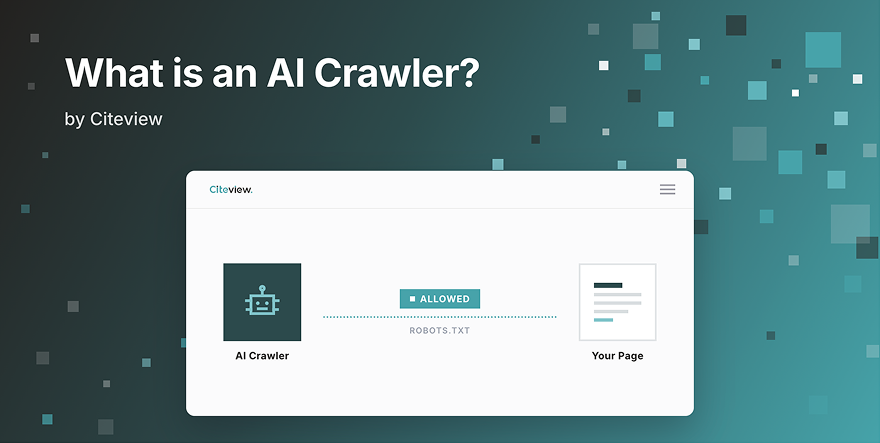
An AI crawler is an automated bot that scans, extracts, and processes web content to feed large language models and AI-powered answer engines like ChatGPT, Claude, Gemini, and Perplexity. Unlike traditional search crawlers that index pages for a results list, AI crawlers ingest content as training data or as live retrieval material used to generate direct answers. When a buyer asks an AI assistant for a category recommendation, the response is built from what these crawlers have already collected, parsed, and stored. That makes AI crawlers the entry point to a new visibility layer, one where brands either appear inside generated answers or disappear from the buying conversation entirely.
How AI Crawlers Work
AI crawlers are bots designed to scan and extract web content to support AI-powered services, from training foundation models to grounding real-time answers with retrieved information. They operate under identifiable user agents such as GPTBot, ClaudeBot, Google-Extended, PerplexityBot, and Bytespider, each tied to a specific model provider and each with distinct crawling behavior. Some, like GPTBot and ClaudeBot, gather content primarily to expand training corpora for future model versions. Others, including PerplexityBot and OAI-SearchBot, fetch pages in real time when a user submits a query, then summarize the retrieved material inside the answer the user reads.
The distinction matters because a page that blocks training crawlers may still be surfaced by retrieval crawlers, and vice versa. AI crawlers also parse content differently than legacy bots, extracting structured meaning, entity relationships, and factual claims rather than storing keywords and backlinks. For a brand, this means the way your product pages, comparison content, and documentation are written directly shapes whether a language model can lift a clean, accurate mention of you into a generated recommendation.
How AI Crawlers Differ From Traditional Web Crawlers
Traditional web crawlers like Googlebot index pages to rank them inside a search results page, while AI crawlers extract content to generate answers that replace that results page entirely. A traditional crawler measures relevance signals, backlinks, page speed, and query match to decide ranking order. An AI crawler cares about factual density, clarity, entity coverage, and how easily a passage can be lifted into a summary.
Traditional crawlers respect a well-established set of conventions built over two decades. AI crawlers introduce new user agents, new consent signals, and new content patterns that most SEO stacks were never designed to handle. The output is the biggest difference: Googlebot sends a visitor to your site, while GPTBot or PerplexityBot may have the model answer the buyer directly, with your brand either named, cited, or ignored.
This shifts the competitive question from “where do I rank on page one” to “which brands does the model name when a buyer asks the category question.” Measuring that requires tracking mentions across ChatGPT, Claude, Gemini, Perplexity, and other major models continuously, because the ranking layer has moved from the search engine to the model itself.
Why AI Crawlers Matter for Your Brand
AI crawlers determine whether your brand appears inside the answers buyers now receive instead of a search results page. When a corporate IT lead asks ChatGPT for a vendor shortlist, or a founder asks Claude to compare three tools, the recommendation is built from content that AI crawlers have already collected, parsed, and stored as retrievable knowledge. If your pages were blocked, malformed, thin, or absent from the crawler’s index, the model has no way to name you, regardless of how strong your traditional search ranking is.
This creates a direct commercial risk. Brands with strong search authority can still register a 0% AI Visibility Score if their content is not structured for extraction. The reverse is also true: smaller brands with well-structured, fact-dense pages often outperform incumbents inside AI answers because the crawlers can pull cleaner mentions from them.
AI crawlers are also the mechanism by which sentiment forms. The phrasing of your comparison pages, case studies, and documentation shapes whether a model describes you positively, neutrally, or negatively. Controlling how these bots see your site is now a core marketing function, not an infrastructure concern.
How Crawlers Affect Both Search and AI Visibility
Web crawlers determine what gets indexed, which directly controls what can rank, and AI crawlers now extend that control from search results into generated answers. Several factors affect both channels simultaneously:
- Indexation coverage: If a crawler cannot reach a page due to robots.txt rules, JavaScript rendering issues, or server errors, that page cannot rank in search and cannot be cited by an AI model.
- Content parsing quality: Crawlers extract headings, structured data, and entity signals. Pages without clean semantic HTML lose visibility in both traditional search results and AI-generated answers.
- Crawl budget allocation: Large sites with thin or duplicate pages waste crawler visits, leaving high-value pages under-indexed and less likely to be surfaced by either search engines or language models.
- User agent permissions: Blocking GPTBot, ClaudeBot, or Google-Extended removes your content from training and retrieval pipelines, which can reduce your AI Visibility Score to zero for the models tied to those agents.
- Citation quality signals: AI crawlers favor sources with clear authorship, publication dates, and factual precision, meaning weak editorial standards now cost you AI citations as well as search authority.
The compounding effect is what many marketing leads miss: a crawlability problem no longer just suppresses a search ranking, it removes you from the generated answer a buyer reads instead of visiting a search engine at all.
AI Crawlability Implementation Checklist
The single most important step is deciding, per user agent, whether you want each AI crawler to access your site, then encoding that decision in robots.txt and server rules so nothing is left to chance. Beyond that, the following steps cover the essentials:
- Explicit user agent rules: Add specific Allow or Disallow directives for GPTBot, ClaudeBot, Google-Extended, PerplexityBot, OAI-SearchBot, and Bytespider rather than relying on wildcard rules that can misfire.
- Server-rendered HTML: Ensure critical product, pricing, and comparison content is present in the initial HTML response, because several AI crawlers do not execute JavaScript reliably.
- Structured data markup: Implement Schema.org types for Organization, Product, FAQPage, and Article so crawlers can extract entities and facts without ambiguity.
- Clear factual density: Write pages with concrete numbers, named comparisons, and unambiguous claims that a model can lift into an answer without paraphrasing away accuracy.
- Log monitoring: Track AI crawler hits in server logs weekly to verify each bot is fetching your priority pages and to catch access regressions early.
Getting this right is only half the work. The other half is measuring whether crawler access actually translates into mentions inside AI answers. Citeview tracks how brands are cited across ChatGPT, Claude, Gemini, Perplexity, and other major models, scoring your AI Visibility Score, Share of Voice, Citation Share, Citation Quality, Sentiment, Average Brand Rank, and Persona tracking against the competitors buyers see alongside you. If you want to see exactly where your brand stands inside the answers your customers are already reading, start a free trial.


