
What is AI Brand Mention Rate?
What is AI Brand Mention Rate?
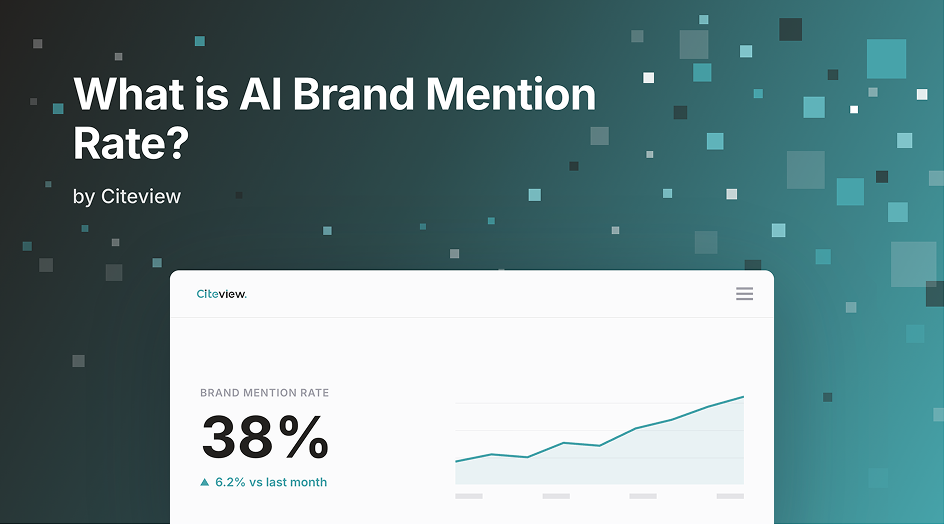
AI Brand Mention Rate is the percentage of times an AI assistant, such as ChatGPT, Claude, Gemini, or Perplexity, names your brand when responding to prompts relevant to your industry, product, or service category. It measures how visible your brand is inside the answers that large language models generate for real user questions. The metric is scored on a 0–100 scale and refreshed on a rolling basis, giving marketing teams a clear signal of whether their brand appears in AI-driven recommendations or gets left out entirely. As buyers increasingly turn to conversational AI instead of traditional search engines, this rate has become a core indicator of digital presence, functioning much like organic ranking did for the past two decades of SEO.
What does AI brand mention rate mean?
AI brand mention rate means the share of AI-generated answers, expressed as a percentage, in which your brand is named when users ask questions related to your category. If your brand appears in 4 out of 16 relevant AI answers, your visibility rate is 25%. The score reflects presence, not sentiment or ranking position on its own, though those are tracked as companion metrics.
The rate is calculated by feeding a curated set of prompts — the same questions your buyers actually ask — into multiple AI models on a recurring schedule. Each response is parsed for brand mentions, and the resulting score is averaged across models and prompt variations. This produces a single, comparable number that shows how often the AI ecosystem surfaces your name unprompted.
Several dimensions sit inside the headline number. Share of Voice compares your mention frequency against competitors named in the same answers. Citation Share measures how often your domain appears as a linked source. Average Brand Rank tracks the position your brand holds when models list options — for example, an average rank of 2.3 places you consistently in the top three. Sentiment classifies whether the tone of each mention is positive, neutral, or negative.
The distinction matters because AI answers behave differently from search results. There is no page one, no ten blue links, and no click-through. Either the model recommends you, or it does not. A brand with strong Google rankings can still register a 0% AI mention rate if models were not trained on, or do not retrieve, the right signals about that brand. That gap is exactly what the metric exposes.
Why is brand mention rate important?
Brand mention rate is important because it directly predicts revenue exposure in the AI channel, where a growing share of product research and buying decisions now happens without a traditional search results page. When your brand is absent from AI answers, prospects never see you, compare you, or shortlist you.
Other key factors include:
- Zero-click discovery is now the default. Users get a single synthesized answer instead of a list. If you are not in that answer, there is no second chance for the user to scroll and find you further down.
- Competitor benchmarking becomes actionable. Share of Voice against rivals shows exactly which competitors the models prefer, in which prompt categories, and by how wide a margin, letting teams prioritize where to close gaps.
- Persona-level insight reveals hidden weaknesses. The same prompt asked from an enterprise IT persona returns different brands than the same prompt from a freelance agency persona. A brand can score 60% with one audience and 12% with another.
- Citation quality drives long-term visibility. Models weight authoritative, well-structured pages more heavily. Tracking which of your pages get cited, and their quality score out of 100, tells content teams which assets are actually feeding the AI layer.
- Sentiment shifts affect trust. A rising negative sentiment share signals a reputation issue that will erode conversion even when mention volume looks healthy.
Tracked weekly, the metric turns AI visibility from a black box into a measurable growth channel. Teams that monitor it can attribute content investments, PR pushes, and product launches to specific movements in the score, treating AI presence with the same rigor once reserved for organic search rankings.
How does AI track brand mentions?
AI brand mention tracking works by systematically prompting multiple large language models with a defined set of buyer questions and then analyzing every response for brand references, citations, and context. The process is automated, repeatable, and runs on a weekly cadence to capture how model outputs evolve.
- Prompt library construction. A structured list of 50 to 500 prompts is built around the questions real buyers ask in the category, covering comparison queries, recommendation requests, and problem-solving scenarios. Each prompt is tagged by intent, funnel stage, and target persona.
- Multi-model querying. The same prompts are sent to ChatGPT, Claude, Gemini, Perplexity, and other assistants in parallel. Running across models is essential because each one draws on different training data and retrieval sources, producing different brand rankings.
- Persona injection. Customer identities such as "enterprise IT manager" or "freelance agency owner" are added to prompts, so results are broken down by audience segment rather than a single baseline.
- Response parsing and entity extraction. Natural language processing scans each answer, identifies brand names, extracts cited URLs, notes the position of each brand in any listed options, and tags the surrounding text for sentiment.
- Metric aggregation. Individual responses are rolled up into headline scores: AI Visibility percentage, Share of Voice, Citation Share, Pages Mentioning You, Citation Quality (0–100), Sentiment classification, and Average Brand Rank.
- Trend tracking and alerts. Scores are compared week over week to surface movement, so a drop from 32% to 24% visibility triggers an alert identifying the specific prompts and models where the loss occurred.
- Competitor mapping. Every rival brand mentioned alongside yours is logged, giving a live picture of the competitive set the models have placed you in — which often differs from the set your marketing team assumed.
The output is a dashboard that continuously answers three questions: how often AI names you, how you compare to competitors, and where your brand ranks when models list options.
How can businesses leverage AI for mentions?
Businesses leverage AI for mentions by treating the AI layer as a distinct marketing channel with its own optimization playbook, separate from SEO and paid media. The starting point is a baseline measurement across every major assistant and every buyer persona, which reveals the gap between assumed visibility and actual model behavior. From there, content teams focus on structured, fact-dense pages that models can parse and cite confidently, because AI systems favor sources with clear entity definitions, concrete data points, and stable URLs. Pairing that with strategic mentions on high-authority third-party sites amplifies the training and retrieval signals models rely on, lifting Citation Share and Citation Quality scores over successive weeks. Persona-level tracking then tells growth teams where to concentrate effort — for example, investing in vertical-specific content when enterprise IT scores lag the baseline by 20 points or more. The most disciplined operators run weekly reviews of their mention rate, share of voice, and average rank, treating each movement as they would a change in organic ranking, and use those insights to reprioritize editorial calendars, PR outreach, and product page updates. To see exactly where your brand stands across ChatGPT, Claude, Gemini, and Perplexity and start closing the gap, Start Free Trial.
Frequently Asked Questions
How is AI Brand Mention Rate calculated?
It is calculated by dividing the number of times AI models mention your brand by the total number of industry-relevant prompts tested, expressed as a percentage.
Why does my brand have a high Google rank but a 0% AI mention rate?
AI models do not rely solely on search engine rankings; they prioritize training data depth, authoritative citations, and synthesized consensus. If your brand lacks these structured signals, AI models will omit you.
Which AI models are used to measure brand mention rate?
The metric is measured across leading large language models and conversational search engines, including ChatGPT, Claude, Gemini, and Perplexity.
How can I improve my AI Brand Mention Rate?
Focus on securing high-quality digital PR, publishing structured data, earning mentions on authoritative industry websites, and ensuring your brand is consistently discussed in context across the web.
What is a good AI Brand Mention Rate?
A good rate depends on your industry, but achieving a 20% to 30% share of voice in your primary product category is a strong benchmark for competitive visibility.
What is the difference between mention rate and share of voice?
Mention rate measures how often you appear across all prompts, while share of voice specifically compares your frequency of appearances against your competitors within those same responses.
Frequently Asked Questions
How is AI Brand Mention Rate calculated?
It is calculated by dividing the number of times AI models mention your brand by the total number of industry-relevant prompts tested, expressed as a percentage.
Why does my brand have a high Google rank but a 0% AI mention rate?
AI models do not rely solely on search engine rankings; they prioritize training data depth, authoritative citations, and synthesized consensus. If your brand lacks these structured signals, AI models will omit you.
Which AI models are used to measure brand mention rate?
The metric is measured across leading large language models and conversational search engines, including ChatGPT, Claude, Gemini, and Perplexity.
How can I improve my AI Brand Mention Rate?
Focus on securing high-quality digital PR, publishing structured data, earning mentions on authoritative industry websites, and ensuring your brand is consistently discussed in context across the web.
What is a good AI Brand Mention Rate?
A good rate depends on your industry, but aiming for a 20% to 30% share of voice in your primary product category is a strong benchmark for competitive visibility.
What is the difference between mention rate and share of voice?
Mention rate measures how often you appear across all prompts, while share of voice specifically compares your frequency of appearances directly against your competitors within those same responses.


