
AI Visibility Metrics Explained
AI Visibility Metrics Explained
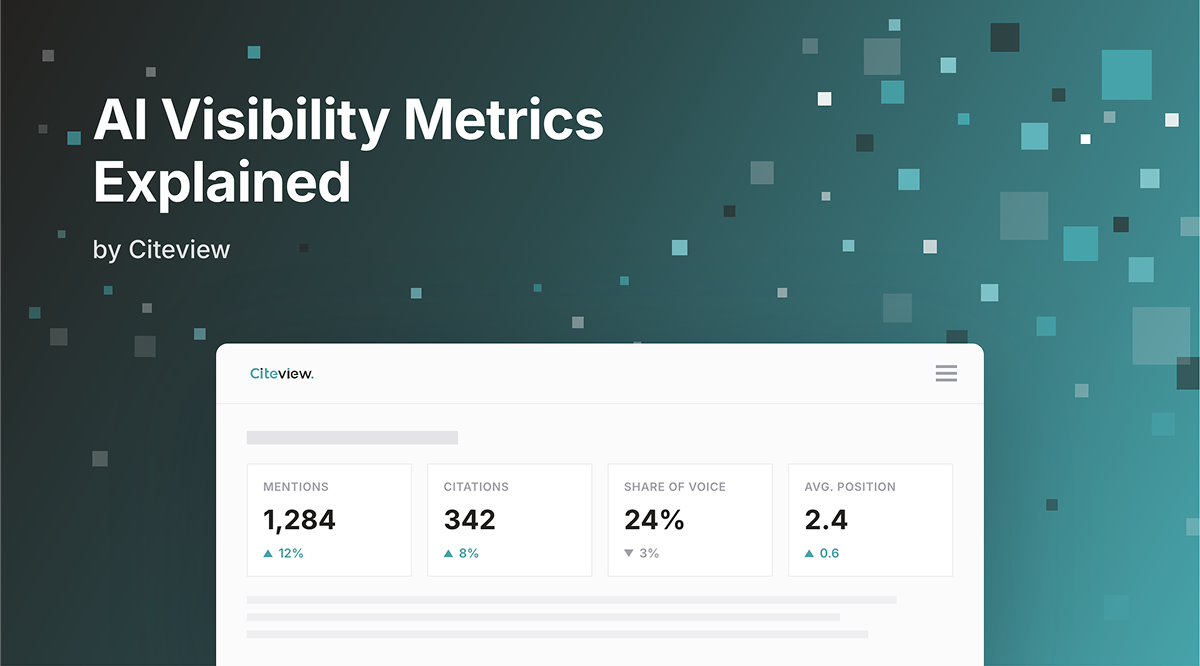
AI visibility metrics are quantitative signals that measure how often, how prominently, and how favorably a brand appears inside answers generated by AI assistants like ChatGPT, Claude, Gemini, and Perplexity. These metrics replace traditional keyword rankings for a new reality: buyers now ask AI directly instead of scrolling through search engine results pages. When a large language model recommends products, cites sources, or lists options, your brand either appears in that answer or it does not. The metrics that quantify that presence—mention rate, share of voice, citation quality, average rank, and sentiment—are what marketing teams now watch as closely as they once watched organic traffic. This article breaks down what these metrics measure, why they matter in 2026, and how brands can turn the data into pipeline.
Defining AI Visibility Metrics in 2026
AI visibility metrics in 2026 describe a compact set of measurements that reveal whether a brand is discoverable inside generative AI answers. The category has consolidated around six core measurements: Brand Mention Rate, Recommendation Rate, Prompt Coverage, Share of Voice, Model-Specific Visibility, and Visibility Volatility. Each one answers a different business question. Mention Rate tells you how often your brand surfaces. Recommendation Rate tells you how often it is actively endorsed. Prompt Coverage maps the breadth of buyer questions where you appear. Share of Voice benchmarks you against every competitor the model names alongside you. Model-Specific Visibility isolates performance inside each assistant, since ChatGPT, Gemini, and Perplexity often return different brand lists for the same prompt. Volatility measures week-over-week stability, a critical signal because model updates can shift rankings overnight. Together, these metrics form the AI equivalent of the traffic-and-rankings dashboards that defined SEO for two decades, except now the ranked surface is a conversational answer, not a blue-link page.
What Are AI Visibility Metrics?
AI visibility metrics are the specific data points that quantify how a brand is represented across generative AI answers, and the single most important one is Brand Mention Rate—the percentage of relevant prompts in which the brand’s name appears at least once.
Other key factors include:
- Recommendation Rate: The share of answers where the model actively suggests your brand as a solution, rather than merely referencing it in passing.
- Share of Voice: Your mention volume divided by the combined mentions of you and every competitor the assistants name in the same category.
- Citation Share: The proportion of source URLs cited by AI that point to your domain, typically expressed as X of Y total citation links.
- Average Brand Rank: The mean position your brand holds when models return an ordered list of options, with a rank of 2.3, for example, signaling consistent top-three placement.
- Sentiment: Whether the tone of AI mentions is positive, neutral, or negative, since a frequent mention paired with negative framing can damage rather than help perception.
- Model-Specific Visibility: A per-assistant breakdown that reveals, for example, that you dominate Perplexity answers but rarely surface in Claude responses.
These metrics together form a 0 to 100 visibility score that tracks how discoverable a brand is across the AI answer layer, refreshed continuously as models update.
Why Do AI Visibility Metrics Matter?
AI visibility metrics matter because millions of buying decisions now begin with a question asked to an AI assistant rather than a query typed into Google, and if your brand is absent from those answers you are effectively invisible to that demand. Traditional SEO metrics like keyword rank and organic sessions do not capture this surface, since AI answers rarely produce a click and often deliver the recommendation directly inside the conversation. Executives need a new dashboard that shows share of voice across ChatGPT, Claude, Gemini, and Perplexity, because losing visibility inside those systems means losing pipeline before a prospect ever reaches your website. These metrics also expose competitive risk in a way search rankings cannot, revealing which rivals are being recommended alongside you, which are pulling ahead, and where the gap is widening. For marketing leaders, they translate an opaque generative layer into concrete numbers that justify budget, guide content strategy, and pinpoint which persona-prompt combinations are underperforming. In short, they turn AI recommendation into a measurable channel.
8 AI Search Visibility Metrics That Matter for Tracking Conversions
The single strongest predictor of AI-driven conversions is Brand Presence—the raw percentage of buyer-intent prompts where your brand appears at all—because no other metric matters if the model never names you.
Other key factors include:
- Citations: The count of unique pages from your domain that AI assistants link to as source material inside their answers, often seven or more for a well-covered brand.
- Share of Voice: Your mention percentage against direct competitors on the exact prompts your buyers ask, commonly benchmarked at around 31% for category leaders.
- AIO Tracking: Coverage inside Google’s AI Overviews specifically, which now intercepts a significant portion of high-intent commercial queries before users reach organic results.
- Citation Quality: A 0 to 100 score that weighs the domain authority, relevance, and topical fit of the pages AI chooses to cite from your site.
- Persona-Adjusted Visibility: The same prompt can produce different answers for an enterprise IT manager versus a freelance agency owner, and tracking both is essential for B2B categories.
- Sentiment Distribution: The split of positive, neutral, and negative framing across every mention, since tone shapes downstream trust.
- Average Position: Where your brand lands in ranked lists returned by the models, with positions one through three driving disproportionate downstream traffic.
These eight metrics form the diagnostic layer that connects AI visibility to actual revenue, not vanity impressions.
How AI Visibility Metrics Are Collected
AI visibility metrics are collected by running a curated set of buyer-intent prompts against every major AI assistant on a scheduled cadence, then parsing each response for brand mentions, citations, rank position, and sentiment. The process follows five repeatable steps.
- Build the prompt library: Compile 100 to 500 high-intent questions your buyers actually ask, covering discovery, comparison, and decision-stage queries across every persona and product line.
- Query every model on schedule: Send each prompt to ChatGPT, Claude, Gemini, Perplexity, and any other target assistant on a weekly or daily cadence, capturing the raw response and any cited URLs.
- Parse mentions and citations: Extract every brand name referenced, the URL of each citation, the ordinal position of your brand in any list, and the sentence-level context surrounding the mention.
- Score sentiment and rank: Classify each mention as positive, neutral, or negative using a language model, and record the average rank position across all answers where your brand appeared.
- Aggregate and benchmark: Roll the parsed data into weekly metrics, compare against the previous period, and benchmark share of voice against every competitor the models named alongside you.
This pipeline produces the continuous, refreshable dataset that makes AI visibility a manageable channel rather than a black box.
How Brands Should Use AI Visibility Metrics
Brands should use AI visibility metrics as an operational feedback loop that directs content investment, competitive positioning, and product messaging toward the prompts where recommendations translate into pipeline. The workflow breaks into five moves.
- Establish the baseline: Measure your current AI visibility score across every assistant and persona before making changes, so improvement is provable rather than assumed.
- Identify the visibility gap: Compare your Share of Voice against the top three competitors on the prompts closest to purchase intent, and rank the gaps from largest to smallest.
- Publish citation-worthy content: Create the specific comparison pages, category explainers, and data-backed resources that AI models prefer to cite, targeting the exact prompts where you are absent.
- Track persona-level performance: Segment every metric by buyer persona, since enterprise IT visibility of 45% paired with SMB visibility of 12% requires two different content responses.
- Iterate weekly on volatility: Watch week-over-week rank movement and act quickly when a model update drops your position, because AI ranking shifts are faster and larger than traditional search results volatility.
Turning these numbers into action is what separates brands that appear in AI answers from those that disappear. To see exactly how your brand ranks across ChatGPT, Claude, Gemini, and Perplexity today, Start Free Trial.
Frequently Asked Questions
What is a good AI Brand Mention Rate?
A good AI Brand Mention Rate is typically 20% or higher within your specific category prompts. Leading brands in highly competitive sectors aim for over 40%, ensuring they appear in nearly half of all relevant conversational queries.
How do AI visibility metrics differ from traditional SEO rankings?
Traditional SEO tracks keyword positions on static search engine results pages. AI visibility metrics measure your brand’s presence, sentiment, and recommendation frequency inside synthesized conversational answers across different large language models.
Why does my brand rank high on Perplexity but not on Claude?
This divergence occurs because different AI assistants use distinct underlying models, training data, and retrieval systems. Perplexity relies heavily on live web indexing, while Claude prioritizes its pre-trained knowledge base and specific context windows.
How can I improve my brand’s AI Recommendation Rate?
Secure high-quality third-party reviews, earn citations on authoritative industry sites, and publish clear, structured content. AI models tend to recommend brands that are consistently validated by trusted external sources across the web.
What causes AI visibility volatility?
Volatility measures how much your brand’s presence in AI answers fluctuates week-over-week. High volatility is usually triggered by core model updates, shifting web sources, or algorithmic adjustments by the AI providers.
How is AI Share of Voice calculated?
Calculate it by dividing your brand’s total mentions by the sum of all brand mentions across a specific set of category prompts. This metric reveals your relative market share within the AI-generated conversational landscape.
Frequently Asked Questions
What is a good AI Brand Mention Rate?
A good AI Brand Mention Rate is typically 20% or higher within your specific category prompts. Leading brands in highly competitive sectors aim for over 40%, ensuring they appear in nearly half of all relevant conversational queries.
How do AI visibility metrics differ from traditional SEO rankings?
Traditional SEO tracks keyword positions on static search engine results pages. AI visibility metrics measure your brand’s presence, sentiment, and recommendation frequency inside synthesized conversational answers across different large language models.
Why does my brand rank high on Perplexity but not on Claude?
This divergence occurs because different AI assistants use distinct underlying models, training data, and retrieval systems. Perplexity relies heavily on live web indexing, while Claude prioritizes its pre-trained knowledge base and specific context windows.
How can I improve my brand’s AI Recommendation Rate?
Secure high-quality third-party reviews, earn citations on authoritative industry sites, and publish clear, structured data. AI models recommend brands that are consistently validated by trusted external sources across the web.
What causes AI visibility volatility?
Volatility measures how much your brand’s presence in AI answers fluctuates week-over-week. High volatility is usually triggered by core model updates, shifting web sources, or algorithmic adjustments by the AI providers.
How is AI Share of Voice calculated?
Calculate it by dividing your brand’s total mentions by the sum of all brand mentions across a specific set of category prompts. This metric reveals your market share within the AI-generated conversational landscape.


