
AI Visibility for B2B’s
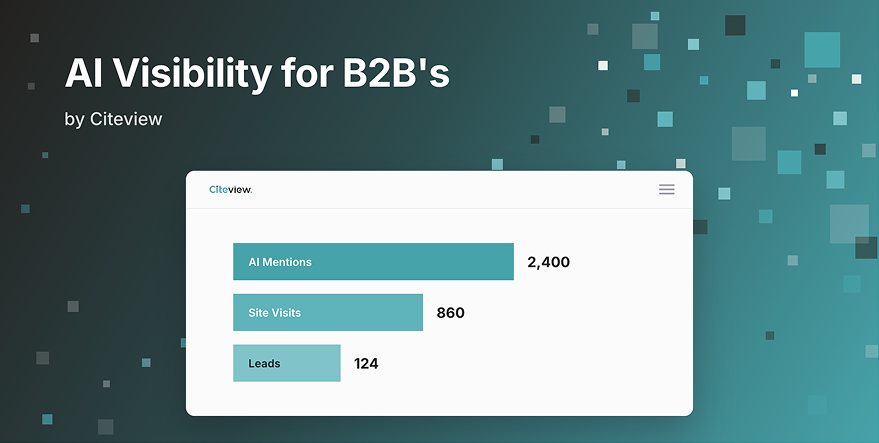
AI visibility for B2Bs is the measurable presence of your brand inside answers generated by ChatGPT, Claude, Gemini, Perplexity, and other large language models when buyers ask category questions. Unlike traditional SEO, which measures rankings on a search results page, AI visibility measures whether your company name appears in the synthesized recommendation an assistant delivers directly to the buyer. A procurement lead asking Claude for “top data warehouse vendors for a 500-person SaaS” gets a shortlist of three to five brands, not ten links. If your name is not in that shortlist, the buyer never sees you. Citeview is an AI visibility platform that gives B2B teams the metrics needed to close that gap: AI Visibility Score, Share of Voice, Citation Share, Citation Quality, Sentiment, and Average Brand Rank, all broken down by buyer persona.
What Is AI Visibility?
AI visibility is the measurable degree to which an AI assistant names your brand when answering questions relevant to your category. It is not a proxy for SEO rank, and it does not correlate cleanly with domain authority. A brand with modest organic traffic can outrank a Fortune 500 competitor inside ChatGPT if its content is structured for retrieval and its name recurs across the sources these models draw from.
Citeview tracks this through six core metrics:
- AI Visibility Score measures how often, how prominently, and how positively an AI assistant names your brand across a defined prompt set, expressed as a 0–100 score.
- Share of Voice measures your mention frequency relative to every competitor the models surface alongside you.
- Citation Share measures how many of the source URLs a model cites belong to your domain.
- Citation Quality assesses the authority and relevance of the sources citing your brand.
- Sentiment classifies each mention as positive, neutral, or negative.
- Average Brand Rank measures your typical position when a model lists options — a 2.3 rank means you consistently land in the top two or three.
Together, these metrics tell a B2B marketer something a traditional rank tracker cannot: whether your brand is being recommended, dismissed, or omitted inside the conversations that now precede many B2B purchases. Buyers no longer scroll through ten results; they read one synthesized paragraph. AI visibility is the discipline of making sure that paragraph includes you.
How AI Models Determine Brand Discoverability
AI assistants determine which brands to recommend through a repeatable pipeline that visibility platforms replicate to produce measurable scores.
- Prompt sampling. A representative set of buyer questions is defined for your category, covering top-of-funnel research (“best CRM for manufacturing”), mid-funnel comparison (“Salesforce vs HubSpot for enterprise”), and bottom-funnel validation (“is Gong worth the price for a 50-rep team”). Coverage typically spans 50 to 500 prompts per category.
- Multi-model execution. Each prompt is run against ChatGPT, Claude, Gemini, Perplexity, and other major models in parallel. Running the same prompt across models is essential because a brand prominent in one assistant may be invisible in another.
- Response parsing. Each answer is parsed for brand mentions, position in the list, surrounding sentiment language, and cited source URLs. Position matters: a brand named first carries more weight than one buried in a footnote.
- Persona injection. The same prompt is re-run with different buyer identities prepended — “as a corporate IT manager at a 2,000-person firm” versus “as a freelance agency owner.” Answers diverge, and the persona-specific scores expose which audience segments actually see your brand.
- Aggregation and scoring. Mentions are aggregated into the six core metrics tracked by Citeview: AI Visibility Score, Share of Voice, Citation Share, Citation Quality, Sentiment, and Average Brand Rank. Regular refresh cycles surface trend lines, so a meaningful drop in average rank can trigger investigation before it becomes a pipeline problem.
- Competitive benchmarking. Your scores are compared against every competitor the models name alongside you, revealing not just where you stand but which rivals are gaining ground in which personas.
Why AI Visibility Matters for B2B Brands
B2B purchase cycles increasingly begin with an AI conversation rather than a traditional search query. When a director of engineering asks an AI assistant to shortlist observability vendors, the response returns a handful of names and a paragraph of reasoning for each. That shortlist frames the entire evaluation: the vendors named become the RFP candidates, and those omitted rarely get a second chance.
For B2B brands, this represents a meaningful structural shift. The assistant collapses discovery, comparison, and recommendation into a single output the buyer often treats as authoritative. Losing visibility inside these answers means losing pipeline before your sales team has any signal to act on. It also means competitors are shaping the buyer’s mental model of the category without you present.
Traditional B2B marketing metrics — organic traffic, MQLs, share of search — do not capture this upstream layer, because the buyer may never land on your site to be measured. AI visibility metrics fill that gap by measuring the recommendation itself, giving marketing and sales leaders a leading indicator of pipeline health that updates far more frequently than a quarterly review.
For mid-market and enterprise teams competing against larger incumbents, the opportunity is notable: models reward clarity, structured content, and consistent third-party corroboration rather than marketing spend alone. A disciplined challenger can achieve strong AI visibility while trailing a category giant on ad share.
How to Audit Your Content for AI Visibility
An AI visibility audit surfaces exactly where your brand is winning, losing, or absent across the assistants your buyers use. Run the process quarterly at minimum.
- Define the buyer prompt set. List 50 to 200 questions your target personas actually ask, spanning category research, competitive comparison, and pricing validation. Use the exact phrasing a buyer would type, not internal marketing language.
- Run prompts across every relevant model. Test ChatGPT, Claude, Gemini, and Perplexity at minimum. Log the full response for each prompt, not just whether your brand appeared.
- Score the six core metrics. Calculate AI Visibility Score, Share of Voice against named competitors, Citation Share of source URLs, Citation Quality, Sentiment per mention, and Average Brand Rank across list positions.
- Segment by persona. Re-run the top 20 prompts with three to five persona prefixes reflecting your actual ICP. Compare persona-specific scores against the no-persona baseline to identify audience-level gaps.
- Map cited sources. Extract every URL the models cite in answers relevant to your category. Note which of your pages appear, which competitor pages dominate, and which third-party publications the models draw from most for your topics.
- Identify content gaps. For prompts where you are absent or ranked low, examine the pages the models favor for winning brands. Look for structural patterns: comparison tables, explicit category definitions, quantified claims, and third-party validation.
- Prioritize fixes and re-measure. Rank interventions by the number of prompts each fix would affect, ship the changes, then re-run the same prompt set 30 days later to confirm score movement.


