
How to Check AI Visibility
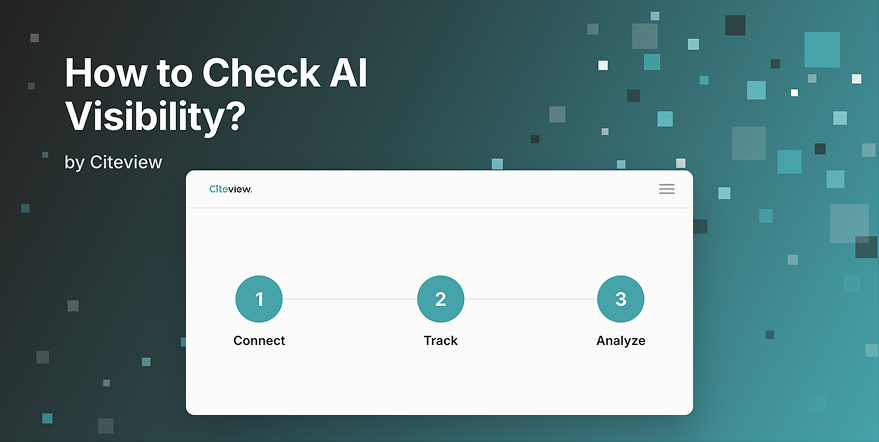
Checking AI visibility means measuring how often and how favorably large language models like ChatGPT, Claude, Gemini, and Perplexity mention your brand when users ask category-defining questions. The process combines automated prompt testing across multiple assistants, tracking mention frequency, share of voice against competitors, citation sources, sentiment, and average brand rank. This article walks through what AI visibility is, how to measure it, why it matters for buyer acquisition, how scoring works, and how often to monitor it. If your brand doesn’t appear when a buyer asks an AI assistant for recommendations in your category, you’re invisible at the exact moment of decision — and that gap widens weekly if left unmeasured.
What Is AI Visibility?
AI visibility is the measurable presence of your brand inside generative AI answers, scored 0–100 based on how frequently assistants name your brand in response to buyer-intent prompts. It replaces the traditional search results page as the moment of discovery. When a corporate IT manager asks ChatGPT “what’s the best endpoint security platform for a 500-person company,” the model returns three to five named recommendations, and that shortlist decides who gets evaluated. If your brand isn’t on it, there’s no click, no impression, no pipeline.
AI visibility differs from SEO because there’s no results page to rank on. A search engine surfaces links a user chooses to click; an AI assistant synthesizes a direct answer from training data, live citations, and contextual signals. Measuring AI visibility requires running the prompts your buyers actually ask, capturing which brands each model surfaces, tracking the citation URLs the model pulls from, and repeating that process across every assistant that matters to your audience. The output is a visibility score, a share of voice percentage, and a competitor benchmark that shows exactly where the gap is and which sources are shaping the answer.
How Do You Measure AI Visibility?
You measure AI visibility by running a defined set of buyer-intent prompts across multiple AI assistants, then quantifying mention frequency, position, sentiment, and citation share. Start by building a prompt library that mirrors real buyer questions in your category: recommendation queries (“best [category] for [use case]”), comparison queries (“X vs Y”), and problem-led queries (“how do I solve [pain point]”). Run each prompt across ChatGPT, Claude, Gemini, Perplexity, and other major models at consistent intervals, log every brand named, capture the citation URLs the model references, and record the position in which your brand appears.
The core metrics are:
- AI Visibility Score — the percentage of prompts where your brand is mentioned
- Share of Voice — your mentions divided by total brand mentions across competitors
- Citation Share — the percentage of citation URLs pointing to your domain
- Average Brand Rank — mean position when your brand appears in a list
- Sentiment — whether the model’s tone toward your brand is positive, neutral, or negative
Layer persona context on top: the same prompt asked as an enterprise IT manager returns different brands than the same prompt asked as a freelance consultant. Manual testing works for a one-time audit; continuous measurement requires a platform that automates prompt runs, tracks changes over time, and alerts you when share of voice shifts.
Why AI Search Visibility Matters
Millions of buyers now ask AI assistants for recommendations instead of typing into a search engine, and the assistant’s answer is the only shortlist they see. When a buyer asks for the top three vendors in your category, they rarely ask a follow-up question that gives an unlisted brand a second chance. Several dynamics make this channel uniquely high-stakes:
- Buyer intent concentration. AI queries tend to be decision-oriented rather than informational, so every mention correlates more directly to pipeline than a typical search impression.
- Zero-click reality. There’s no results page to rank on. If the model doesn’t name you, you don’t exist in that session.
- Finite competitor sets. AI answers surface three to seven brands at most. Every competitor named alongside you is one you’re being compared against in real time.
- Citation compounding. The URLs a model cites when justifying its answer influence future answers. Building citation share creates a reinforcing visibility advantage over time.
- Persona-specific outcomes. The same prompt asked by different audience segments returns different brands, meaning visibility is a matrix of scores per buyer persona, not a single number.
Brands that measure AI visibility early get to influence how models describe their category before a competitor establishes the default narrative.
How Does AI Visibility Scoring Work?
AI visibility scoring converts raw assistant responses into a normalized 0–100 score by measuring how consistently your brand appears across a defined prompt set and audience mix. The process follows five steps:
- Define the prompt set. Build a library of buyer-intent prompts covering recommendation, comparison, and problem-led queries relevant to your category. The prompts must reflect real questions your target buyers ask, not internal marketing language.
- Run prompts across assistants. Execute every prompt against ChatGPT, Claude, Gemini, Perplexity, and other major models your audience uses. Repeat runs on a weekly cadence to capture drift, since model updates and training refreshes shift answers continuously.
- Capture and tag responses. Log the full text of each answer, extract every brand mentioned, record each brand’s position in any list, capture citation URLs, and classify sentiment as positive, neutral, or negative.
- Calculate composite metrics. Aggregate the raw data into AI Visibility Score, Share of Voice, Citation Share, Sentiment, and Average Brand Rank. Weight the composite score by prompt importance if certain queries drive more pipeline than others.
- Segment by persona. Re-run the same prompts with different buyer identities — such as enterprise IT manager, freelance agency owner, or procurement lead — to produce a per-persona visibility breakdown that reveals which audiences see you and which don’t.
The final score is a single number, refreshed weekly, that shows whether you’re gaining or losing ground in the answers that shape purchase decisions.
How Often Should You Monitor AI Mentions?
Monitor AI mentions weekly at minimum, with alert-based checks for high-priority prompts running daily. AI assistants update their training data, retrieval sources, and ranking logic continuously, and a brand that held 40% share of voice one week can drop significantly the next when a competitor publishes a widely cited comparison piece.
A weekly cadence catches directional shifts, competitor moves, and sentiment changes early enough to respond. Daily alerts on your top revenue-driving prompts flag sudden drops before they compound into pipeline loss. Monthly or quarterly monitoring is too slow for this channel; by the time you notice a decline, competitors may have already reinforced their citation footprint and shaped the model’s default answer.
Continuous tracking also lets you measure the impact of specific actions — publishing a new comparison page, earning a citation on a high-authority source, or launching a PR campaign — by correlating timing with movement in your visibility metrics. Useful alert thresholds include a 5-point drop in AI Visibility Score, a 10% swing in Share of Voice, or the appearance of a new competitor in your top citation set.
Citeview automates every step above — persona-segmented tracking, weekly score refreshes, Citation Share monitoring, and competitor benchmarking across ChatGPT, Claude, Gemini, Perplexity, and other major models — so you always know where you stand in the answers your buyers see.


