
What Are GEO Metrics and How Do They Work?
What Are GEO Metrics and How Do They Work?
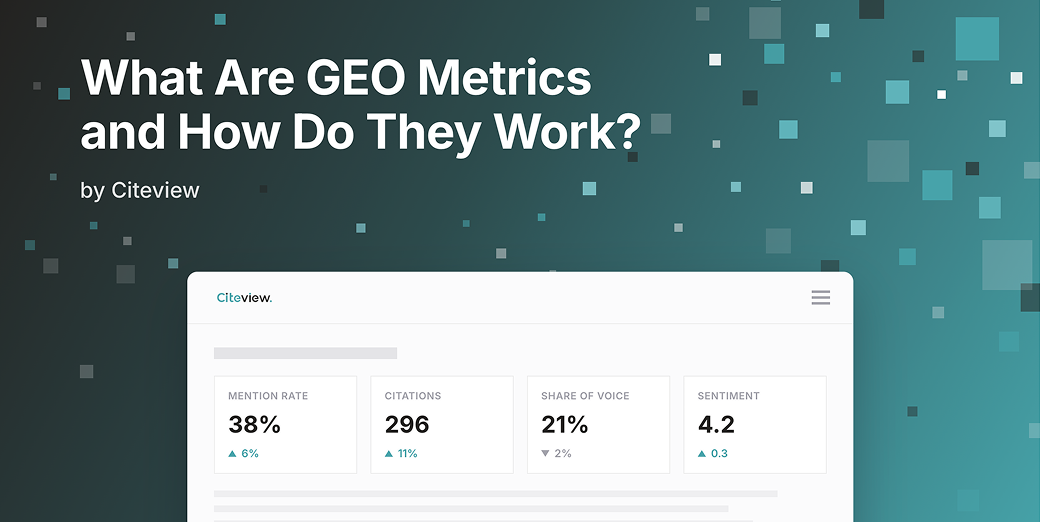
GEO metrics are the measurement signals that show how often, how prominently, and how favorably a brand appears inside answers generated by AI assistants like ChatGPT, Claude, Gemini, Perplexity, Copilot, and Grok. They translate the invisible world of AI-generated recommendations into scores a marketing team can track, benchmark, and improve week over week.
Traditional SEO metrics track blue-link rankings on a search results page. GEO metrics track something entirely different: whether an AI model names your brand when a real buyer asks a real question. As generative engines replace the classic ten-blue-links experience for millions of buying decisions, GEO metrics have become the new scoreboard for brand visibility. This guide breaks down what they measure, which numbers matter, how to improve them, and where their limits lie.
What is GEO Metrics?
GEO metrics, short for Generative Engine Optimization metrics, are a set of measurable indicators that quantify how AI assistants represent your brand inside their generated answers. The core signal is simple: when a potential customer asks an AI model a question relevant to your category, does the model mention you, cite you, rank you highly, and describe you positively?
These indicators are gathered by running large, repeated batches of category-relevant prompts across multiple AI engines, then parsing the responses for brand mentions, citation links, ranking positions, and sentiment tone. The result is a dashboard of scores that behaves similarly to a rank tracker, but for AI answers instead of search engine results pages.
GEO metrics differ from classic SEO metrics in three important ways. First, the surface being measured is a generated paragraph, not a ranked list of URLs. Second, results shift based on prompt phrasing, user persona, and model version, so measurement requires continuous sampling rather than a single snapshot. Third, the outcome for the user is often a single recommendation rather than a page of options, which raises the stakes of being named.
Thousands of brands now actively use GEO measurement platforms across nine or more AI engines, reflecting how quickly buying research has shifted from traditional search to conversational AI. For any executive whose customers now ask a chatbot before opening a browser, GEO metrics answer the essential question: are we in the answer, or are we invisible?
List of GEO Metrics
AI Visibility is the foundational GEO metric, measuring the percentage of relevant answers in which your brand is named at all, scored on a 0 to 100 scale and refreshed on a weekly cadence. A visibility score of 25% means your brand appeared in 1 out of every 4 answers to prompts that matter for your category. Other core metrics include:
- Share of Voice: the percentage of total brand mentions across your competitive set that belong to you. A 31% share of voice means nearly one in three mentions across all rival brands is yours.
- Citation Share: the proportion of source URLs that link to your domain when the AI cites its references. A score of 33% means 1 of every 3 citation links points to you.
- Average Brand Rank: your typical position when the model lists multiple options. An average rank of 2.3 places you consistently among the top two or three recommendations.
- Citation Quality Score: a 0 to 100 rating of how authoritative the pages linking to your site are, with a score of 82 indicating strong domain trust signals feeding the models.
- Pages Mentioning You: the count of unique URLs from your domain that AI models cite, showing content depth and topical breadth.
- Sentiment: the positive, neutral, or negative tone of AI mentions, revealing whether models describe your brand favorably.
Together these metrics form a complete picture, moving beyond a single vanity number to a diagnostic view of where visibility is strong, where citations are thin, and where sentiment needs attention.
Strategies to Improve AI Visibility with GEO Metrics
Publish deep, well-structured expertise pages that directly answer the buying questions your category faces, because AI models draw disproportionately from content that resolves a query in one place. Well-scoped answer content raises both citation share and pages-mentioning-you counts within weeks.
- Build citation-worthy assets: publish original data, comparison tables, and benchmark studies. Models favor sources that provide unique numbers rather than restated opinions.
- Optimize for prompt variety: track the actual phrasings buyers use, then create content that answers each phrasing directly, including persona-specific variants for enterprise, mid-market, and freelance audiences.
- Earn mentions on high-authority third-party pages: reviews, industry directories, and expert roundups feed model training and retrieval layers, boosting citation quality scores.
- Structure content for extraction: use clear H2 questions, concise 40 to 60 word answer paragraphs, and factual bullet lists so language models can lift and attribute your content cleanly.
- Monitor sentiment drivers: identify the review sites, forums, and news pages shaping your tone score, then address negative narratives at the source rather than in the AI output.
The compounding effect matters here. A brand that lifts AI Visibility from 25% to 45% typically sees Share of Voice, Average Brand Rank, and Citation Share improve in parallel, because the same content and authority signals feed every metric. Treating GEO metrics as one interconnected system, rather than as isolated scores to game individually, produces the most durable gains.
Challenges and Limitations of GEO Metrics
GEO measurement is powerful but still maturing, and executives should understand both what these metrics can and cannot tell them before allocating budget.
Pros
- Direct visibility into a previously invisible channel: for the first time, brands can quantify their presence inside AI answers rather than guessing.
- Competitive benchmarking: share of voice and average rank scores show exactly where your gap against rivals is widening or closing.
- Persona-level insight: the same prompt returns different answers for a corporate IT manager versus a freelance agency owner, and modern tools expose that variance.
Cons
- Modeled estimates mixed with real signals: some platform scores blend directly observed AI outputs with statistical modeling, and the two are not always clearly separated on dashboards.
- Prompt sensitivity creates noise: small changes in wording can produce large swings in mentions, requiring large sample sizes to generate stable weekly scores.
- Limited access to underlying platform data: OpenAI, Anthropic, and Google do not publish query volumes or ranking logic, so all GEO metrics are inferred from external sampling rather than first-party data.
The honest read is that GEO metrics are directionally reliable and improving quickly, but should be interpreted as a well-calibrated telescope pointed at AI answers, not a first-party analytics feed. Combining GEO scores with pipeline data, branded search trends, and referral analytics from AI sources produces the most trustworthy overall view.
What KPIs Should Businesses Track for GEO Success?
AI Visibility percentage is the single most important KPI, because it captures the top-of-funnel question every executive needs answered: when buyers ask AI about our category, how often are we in the room? A weekly visibility trend line is the closest GEO equivalent to organic traffic in classic SEO. Beyond that headline number, businesses should track:
- Share of Voice against a defined competitive set: pick 5 to 10 direct rivals and monitor your percentage of total mentions weekly, so you can spot competitor surges before they cost pipeline.
- Average Brand Rank: being named 8th in a list of 10 is not the same as being named 1st or 2nd. Track the average position and target sustained top-3 placement.
- Citation Share and Citation Quality: these two together indicate whether AI models trust your domain enough to link back, which drives referral traffic from AI answer surfaces.
- Persona-Segmented Visibility: track visibility separately for each buyer persona relevant to your business. An aggregate score of 35% can mask a significantly lower score for your highest-value enterprise segment.
- Sentiment Distribution: monitor the positive, neutral, and negative share across all mentions monthly, since a rising visibility score paired with rising negative sentiment is a warning signal, not a win.
Reporting these KPIs to executive stakeholders in a single weekly scorecard turns GEO from an experimental initiative into a governed growth channel. When AI-driven discovery already shapes buying decisions across most B2B and consumer categories, the brands measuring these metrics rigorously will be the ones AI recommends tomorrow. See exactly where your brand stands across every major AI engine and start closing the visibility gap today: Start Free Trial
Frequently Asked Questions
What is the main difference between SEO and GEO metrics?
SEO metrics track blue-link rankings on search results pages, while GEO metrics measure your brand's presence, citations, and sentiment within AI-generated conversational answers.
How do you calculate AI Visibility in GEO?
AI Visibility is calculated by running category-relevant prompts across multiple AI engines and dividing the number of times your brand is mentioned by the total number of prompts, expressed as a percentage.
Why does my brand's GEO visibility score change so frequently?
AI models continuously update their training data, adjust weights, and generate answers dynamically based on prompt phrasing and user context, causing scores to fluctuate more than static search engine rankings.
What is a good GEO Share of Voice percentage?
A strong Share of Voice is typically 25% or higher, meaning your brand captures at least one-quarter of all competitive mentions within your industry's AI-generated responses.
How can I improve my brand's Citation Share in AI answers?
Publish high-authority, structured content that directly answers industry questions, and secure mentions on reputable third-party sites that AI models frequently use as reference sources.
Which AI engines are tracked using GEO metrics?
GEO metrics track major conversational engines and AI assistants, including ChatGPT, Claude, Gemini, Perplexity, Copilot, and Grok.
Frequently Asked Questions
What is the main difference between SEO and GEO metrics?
SEO metrics track blue-link rankings on search results pages, while GEO metrics measure your brand's presence, citations, and sentiment within AI-generated conversational answers.
How do you calculate AI Visibility in GEO?
AI Visibility is calculated by running category-relevant prompts across multiple AI engines and dividing the number of times your brand is mentioned by the total number of prompts, represented as a percentage.
Why does my brand's GEO visibility score change so frequently?
AI models continuously update their training data, adjust weights, and generate answers dynamically based on prompt phrasing and user context, causing scores to fluctuate more than static search engine rankings.
What is a good GEO Share of Voice percentage?
A strong Share of Voice is typically 25% or higher, meaning your brand captures one-quarter of all competitive mentions within your industry's AI-generated responses.
How can I improve my brand's Citation Share in AI answers?
Publish high-authority, structured content that directly answers industry questions, and secure mentions on reputable third-party sites that AI models frequently use as reference sources.
Which AI engines are tracked using GEO metrics?
GEO metrics track major conversational engines and AI assistants, including ChatGPT, Claude, Gemini, Perplexity, Copilot, and Grok.


