
What is “Share Of Voice” in AI search?
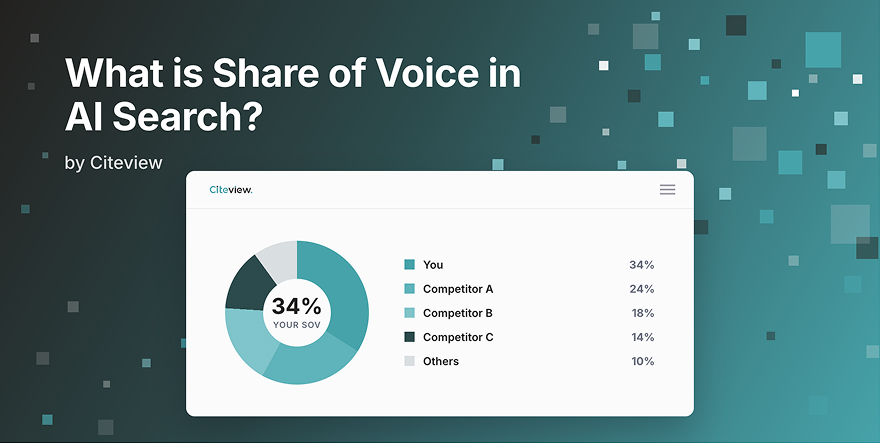
Share of Voice (SOV) in AI search is the percentage of brand mentions your company receives compared to competitors across AI-generated answers from assistants like ChatGPT, Claude, Gemini, and Perplexity. It measures how much of the conversation your brand owns when buyers ask AI for recommendations, comparisons, or category advice. Unlike traditional SOV, which counts ad impressions or press mentions, AI Share of Voice counts the times a large language model actually names your brand inside a response. That distinction matters because the answer is the interface now, and the brands cited inside it capture the click, the consideration, and often the purchase. Citeview tracks this metric continuously across ChatGPT, Claude, Gemini, Perplexity, and other major models, measuring Share of Voice alongside related signals like Citation Share, Citation Quality, Sentiment, AI Visibility Score, and Average Brand Rank across the prompts your buyers actually use.
What does AI share of voice mean?
AI Share of Voice is the ratio of your brand’s mentions to the total brand mentions returned by AI assistants across a defined set of prompts, expressed as a percentage. If a buyer asks ChatGPT for the top project management tools and the model names ten brands across a hundred variations of that question, and yours appears in thirty-one of them while competitors split the remaining sixty-nine, your Share of Voice is 31%. The metric is prompt-scoped, meaning it only counts within the category questions relevant to your market, not the entire internet. It also treats each mention as a discrete signal, so being named first alongside four competitors counts differently than being the only brand recommended. Most platforms calculate it against a fixed competitor set you define, which lets you see the true split of attention inside your category rather than diluting the number against irrelevant brands. It is one of the clearest indicators of whether AI models have absorbed your brand into their working knowledge of a market, or whether your competitors have crowded you out of the answer entirely.
Why is AI share of voice critical for brands?
AI Share of Voice is critical because AI assistants now function as a filter between buyers and brands, and if you are not named in the answer, you are functionally absent from the consideration set. Buyers increasingly ask ChatGPT, Gemini, and Perplexity for recommendations instead of scrolling a search results page, and the shortlist those models produce shapes purchasing decisions before a human ever visits a website. A brand with a 5% Share of Voice appears in one out of twenty AI answers; a competitor with 40% appears in eight. That gap compounds into pipeline, revenue, and category perception over time.
Traditional SEO metrics like keyword rank do not capture this shift. AI assistants rarely surface a ranked page directly — they synthesize an answer that names some brands and omits others entirely. Executives tracking only organic traffic will miss the erosion until it shows up in demo requests or trial signups. Measuring AI Share of Voice early gives marketing teams a leading indicator of demand, a defensible benchmark against competitors, and a specific target for the content, PR, and citation work required to keep the brand inside the answer.
How can you measure AI share of voice?
You measure AI Share of Voice by running a fixed set of category prompts against each major AI assistant on a repeating schedule, counting how often your brand is mentioned versus each competitor, and dividing your mentions by the total. The prompt set should mirror how real buyers phrase questions — “best CRM for a 50-person sales team,” “alternatives to HubSpot for B2B SaaS,” “top cybersecurity vendors for financial services” — rather than branded queries that force your name into the answer.
Each prompt should be run across ChatGPT, Claude, Gemini, and Perplexity because the models pull from different training data and citation sources, and Share of Voice varies significantly between them. Run the same prompts weekly to track movement, and segment by persona — injecting identities like “as an enterprise IT director” or “as a startup founder” — to see how answers shift by audience. Manual tracking works for a handful of prompts, but categories with dozens of buyer questions and multiple AI models produce thousands of data points per week, which is where a dedicated tracking platform becomes necessary. The output is a percentage per model, per persona, per prompt, refreshed on a consistent cadence.
What benchmarks define AI share of voice success?
Healthy benchmarks depend on category concentration, but as a general guide, the top three brands in any category typically capture the majority of combined mentions, with the leader holding a substantially larger share than challengers. If your category has five to seven serious competitors, a Share of Voice above 20% generally places you in the leadership tier; between 10 and 20% puts you in the challenger group; below 5% signals you are largely invisible in AI answers.
These numbers also shift by model. Perplexity tends to distribute mentions more evenly because it cites live sources, while ChatGPT can concentrate mentions on brands most prominent in its training data. The more actionable benchmark is directional: is your Share of Voice climbing week over week, holding flat, or slipping? Pair the number with Average Brand Rank — the average position your brand takes when the model lists options — because a 20% Share of Voice at rank 1.5 is meaningfully stronger than 25% at rank 4.2. Success is defined by trajectory, position, and persona coverage, not a single headline percentage.
Strategies to improve AI share of voice
Publish authoritative, citation-worthy content on the specific questions your buyers ask AI, because models pull from pages that answer category questions directly and with structured, factual depth. Other key factors include:
- Earn third-party mentions in high-authority sources. AI models weight brands mentioned across independent publications, review sites, forums, and industry reports. A single comparison article or community thread can shift Share of Voice inside a specific model.
- Structure content for extraction. Use clear H2 questions, direct first-sentence answers, comparison tables, and specific numbers. Models pull from content that maps cleanly to the shape of the answer they are constructing.
- Cover the full prompt landscape. Map every variation of how buyers ask about your category — alternatives, comparisons, use-case queries, and persona-specific questions — then publish content that places your brand clearly inside each context.
- Monitor citation sources per model. Perplexity, Gemini, and ChatGPT surface different domains. Track which URLs each model cites for your category and prioritize placements on those specific sources.
- Track persona-level results. A 30% Share of Voice at the baseline can collapse to 8% when the prompt specifies “enterprise buyer,” revealing content gaps that are invisible in aggregate reporting.
Consistent measurement is the foundation. Without regular tracking across models and personas, none of these tactics can be tied to real movement in the number. See exactly where your brand stands across every major AI assistant and start closing the gap today.


